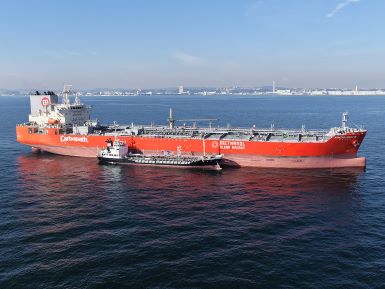
Mitsui O.S.K. Lines announced Japan’s first ship-to-ship bunkering of methanol vessel fuel at anchorage.
The company teamed up with the City of Yokohama, Kokuka Sangyo Co, Idemitsu Kosan Co, and Mitsubishi Gas Chemical Company – collectively known as the “Five Parties” – to successfully complete the endeavour.
Methanol fuel was transferred from the Eika Maru to the Kohzan Maru VII in the Yokohama District of Keihin Port. The Eika Maru is a coastal methanol transport vessel operated by Kokuka Sangyo and the Kohzan Maru VII is a dual-fuel, ocean-going, methanol-transport vessel operated by MOL, and both are chartered by MGC.
This operation also used domestically produced bio-methanol from MGC’s Niigata Plant, which is scheduled to be used as fuel for the future operation of the Kohzan Maru VII.
Methanol, a basic chemical, is used in a wide range of applications. It is also recognized as a clean-burning fuel, emitting low levels of CO2, sulphur oxides (SOx), nitrogen oxides (NOx), and particulate matter (PM). In the shipping industry, adopting alternative fuels to replace heavy fuel oil is one strategy for reducing GHG emissions. Methanol is gaining attention as a promising alternative fuel due to its ease of handling within existing infrastructure, leading to an increase in orders for methanol-fueled vessels. Methanol produced from non-fossil sources-such as CO2, waste plastics, and biobased feedstocks-enables carbon-neutral marine transport across its entire lifecycle.
The bunkering operation at this anchorage was made possible based on findings from a methanol bunkering simulation conducted in Yokohama Port in September 2024 and other insights related to the domestic transport of chemicals, including methanol. Those insights were brought by multiple stakeholders, including the operators (the Five Parties). Stakeholders and MLIT, along with the Japan Coast Guard discussed procedures and safety measures for implementation, which contributed to the successful execution of this operation.
This project marks Japan’s first ship-to-ship methanol bunkering operation at anchorage for methanol-fueled vessels in service, representing a significant milestone in promoting methanol bunkering within Japan. Moving forward, stakeholders will systematically organize and visualize insights gained through post-operation verification of this project. The Five Parties expect that these findings will be applied to methanol bunkering operations involving other vessel types or in other regions of Japan.
Building on this project as a starting point, MOL will continue advancing initiatives to further develop and promote methanol bunkering throughout Japan. Since commencing operations of the world’s first methanol dual-fuel vessel in 2016, MOL has deployed eight such carriers, operating one of the world’s largest fleets of dedicated methanol carriers.